
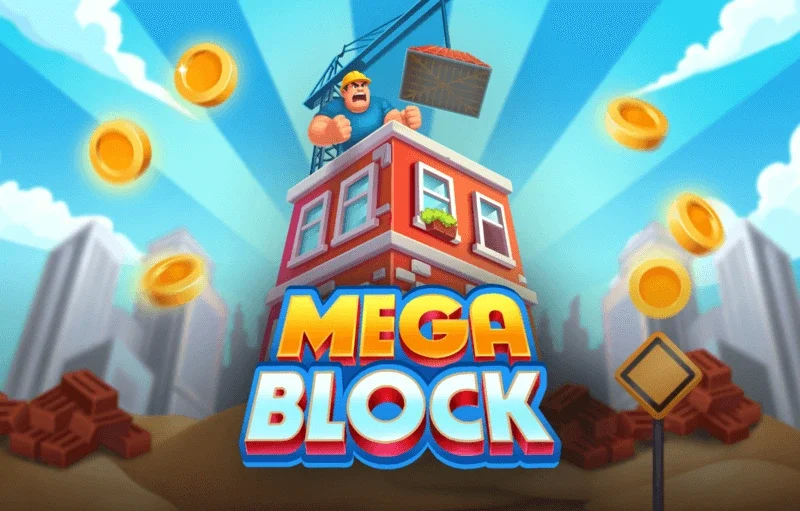
MegaBlock Tower Building Game Overview
MegaBlock is a tower building game from InOut Games, released on February 10, 2026. The concept is straightforward: a crane swings above a construction site, you press "Go" to drop each block, and every successful placement pushes your multiplier higher. Miss the timing or let the tower collapse — and the round is over. It sounds simple, but once the stack starts growing and the multiplier climbs, you'll feel exactly why this game has picked up a serious following so quickly.
Two mechanics drive everything: a block placement system that rewards timing and focus, and a variable multiplier that scales based on your chosen difficulty and how high your tower reaches. The maximum win sits at 2,941,884x your bet — achievable on Hardcore mode for players willing to push the limits.
A construction theme that keeps focus where it matters
The visual design is clean and deliberate: cartoon construction worker, colorful building blocks, a city skyline in the background, cranes and machinery framing the action. There's no clutter, no distracting animations fighting for your attention. Everything points back to the tower and the decision you're about to make — drop the block or cash out.
Sound design follows the same logic. Effects build tension during placement and give clear feedback on hits and misses, without becoming grating after 30 rounds. You can chain sessions without reaching for the mute button.
Why MegaBlock works differently from standard crash games
Most crash games give you a single lever: bet, watch a multiplier climb, pull out before it crashes. MegaBlock adds a physical dimension to that decision. You're not watching a number — you're building something. Each block you place is a visible, tangible commitment. That shift from passive watching to active building is exactly what makes the MegaBlock casino game feel more engaging than the typical crash format.
The 4 difficulty levels — Easy, Medium, Hard, and Hardcore — function as a volatility dial you set before the round starts. Easy gives you up to 24 blocks with lower risk and steadier multipliers. Hardcore caps you at 15 blocks but opens the door to extreme payouts. This means two players can run completely different strategies on the same game, which is rare in the instant game category.
Mobile play — no app, no compromise
MegaBlock runs in HTML5 directly in any mobile browser — no download, no installation. The interface adapts to both portrait and landscape, with touch controls sized for actual thumbs. Bet amount, current multiplier, and balance stay visible at all times without hunting through menus.
The game loads fast and holds up well on 4G/5G once the assets are cached after your first session. For the smoothest first experience, Wi-Fi is recommended — after that, mobile data handles it fine. Provably Fair technology is built into every round, meaning each outcome can be independently verified using cryptographic hash values. You don't have to take anyone's word for it.
How to Play MegaBlock?
Getting started with MegaBlock is straightforward — the game runs through any online casino that carries InOut Games titles. Here's what the process looks like from zero to your first round.
Find a casino that offers InOut Games
MegaBlock isn't a standalone app — you play it through a licensed online casino. Look for platforms that clearly show their licensing details (Malta Gaming Authority or Curacao eGaming are the benchmarks), offer decent customer support, and ideally give you access to the MegaBlock demo before you commit real money. Playing through verified casino links is the safest way to avoid unlicensed operators that could put your funds at risk.
Fund your account and set a budget
Once registered, deposit using your preferred payment method and decide on a session budget before you start playing — not after. MegaBlock can deliver consistent wins, but the difficulty scaling means rough patches happen. A practical starting point is enough balance for 100–200 rounds, which gives you enough runway to find your rhythm without overexposing yourself. Never chase losses by depositing again mid-session.
Find MegaBlock in the casino lobby
Look for MegaBlock in the Instant Games or Arcade section of the casino lobby. Most platforms let you filter by provider — select InOut Games and you'll find it immediately. If no filter is available, just type "MegaBlock" in the search bar. The game loads directly in your browser, no installation needed, and you can switch between real money and demo mode from the same interface.
Set your bet and difficulty level
Before each round you configure two things: your bet amount ($0.10–$100.00) and your difficulty level. These two settings together define your entire risk-reward profile for the session. Here's what each difficulty actually means in practice:
- Easy — up to 24 blocks, multiplier range 1.01x–23.75x. Best for learning the timing and playing conservatively.
- Medium — balanced risk, moderate multiplier ceiling. Good for regular sessions once you're comfortable.
- Hard — fewer blocks, steeper multiplier curve. Rewards discipline and precise timing.
- Hardcore — up to 15 blocks, multiplier range 1.6x–2,941,884x. High risk, extreme upside. Not for the faint-hearted.
If you prefer a more automated approach, enable Auto Game mode to set a fixed number of rounds and a pre-defined cashout point. It's a useful tool for bankroll management — you define your exit strategy before emotion gets involved.
Build your tower and cash out at the right moment
Once you press "Go", the crane drops a block onto your tower. Every successful placement increases your multiplier. The tension is real — the higher the tower, the bigger the reward, but also the higher the chance that the next block ends the round. You can hit Cash Out at any point to lock in your current multiplier and walk away with the winnings.
On Easy mode, the multipliers build gradually and the game forgives small mistakes. On Hardcore, every single block matters — the multiplier jumps are dramatic, but one bad placement and it's over. Most experienced players recommend finding your cashout comfort zone early and sticking to it, rather than always pushing for the top of the tower.
MegaBlock Tower Building Game Mechanics
Once you understand how MegaBlock's core systems work, the game becomes a lot more than just pressing "Go" and hoping for the best. The difficulty system, multiplier scaling, and timing mechanics all interact — and knowing the details gives you a real edge when deciding how to play each session.
Difficulty levels and block limits
MegaBlock offers four difficulty levels, each defining a completely different risk profile. The fewer blocks available, the steeper the multiplier curve — and the bigger the potential payout if you make it to the top.
| Difficulty | Max Blocks | Multiplier Range |
| Easy | 24 | 1.01x to 23.75x |
| Medium | 22 | 1.09x to 2,116x |
| Hard | 20 | 1.2x to 48,348x |
| Hardcore | 15 | 1.6x to 2,941,884x |
Easy mode is the natural starting point — 24 blocks, gradual multiplier growth, low variance. It's where you learn the timing without burning through your balance. Medium and Hard start compressing the block count while pushing the multiplier ceiling into genuinely interesting territory. Hardcore is a different game entirely: 15 blocks, each one mattering more than the last, with a theoretical ceiling of 2,941,884x for anyone who stacks the full tower.
Block placement and timing
The crane swings a block above your tower, and you decide exactly when to drop it. A clean placement adds a floor and bumps your multiplier. A missed placement ends the round and you lose your stake. That's the entire loop — but the psychological pressure it creates is anything but simple.
Early in the tower, the risk is low and the margin for error is forgiving. As you get higher, each block carries more weight. The real-time multiplier display keeps your current potential payout visible at all times, which makes the cashout decision a constant calculation: lock in what you have, or go one block further. Most players find that pressure is exactly what keeps them coming back.
Auto Game and session recovery
Auto Game mode lets you pre-configure a set number of rounds with a fixed cashout trigger — either by multiplier level or block count. It's the closest thing MegaBlock has to a disciplined strategy tool, removing the temptation to override your exit point mid-round when the multiplier starts looking attractive. Set your parameters before the session, not during it.
The game also includes session recovery: if your connection drops or you accidentally close the browser mid-round, MegaBlock restores your last active round when you return. Your tower progress isn't lost to a bad Wi-Fi moment.
Provably Fair — how it actually works
Every round in MegaBlock is governed by Provably Fair technology, which means the outcome of each block placement is determined before the round starts — using a combination of server seed, client seed, and nonce. The result is cryptographically locked from the moment you press Play, and you can independently verify any round after it completes using the hash values provided in the game interface.
This matters because it means neither the casino nor InOut Games can influence the outcome of your session. The system is auditable by anyone, not just regulators. For players who've had doubts about whether online games are actually fair, Provably Fair removes the guesswork entirely.
MegaBlock Game: RTP, Volatility, Maximum Win
MegaBlock runs on a 95.5% RTP — slightly below the 96%+ you'll find on some slots, but that number alone doesn't tell you much about how this game actually behaves. The more important detail is that volatility in MegaBlock isn't fixed. It shifts based on the difficulty level you select before each round, which means you're effectively choosing a different game profile every time you sit down to play.
What 95.5% RTP actually means in practice
RTP — Return to Player — is a long-term statistical figure. A 95.5% RTP means that over a very large number of rounds, the game returns $95.50 for every $100 wagered in total. That remaining 4.5% is the house edge built into the math. It does not mean you'll win 95.5% of your individual rounds — short sessions can swing wildly above or below that number depending on variance.
The key thing to understand is that RTP is consistent across all four difficulty modes. What changes is how that return is distributed. Easy mode spreads it across frequent smaller wins. Hardcore compresses it into rare, massive payouts. Same mathematical return, completely different session experience.
Volatility by difficulty level
MegaBlock's variable volatility system is what separates it from most crash games on the market. Instead of a single fixed risk curve, you get four distinct profiles:
- Easy (24 blocks, 1.01x–23.75x) — Low volatility. Wins come frequently, multipliers grow steadily. You'll lose rounds, but rarely in long brutal streaks. Good for learning the timing, testing strategies, or playing with a smaller bankroll.
- Medium (22 blocks, 1.09x–2,116x) — Medium volatility. A real step up from Easy — the multiplier ceiling jumps dramatically, but so does the risk of early collapse. Suits players who want meaningful payouts without the extreme swings of Hard.
- Hard (20 blocks, 1.2x–48,348x) — High volatility. Losing streaks become a real factor here. Patience and strict cashout discipline are necessary. The reward for navigating a tall tower on Hard is genuinely significant.
- Hardcore (15 blocks, 1.6x–2,941,884x) — Extreme volatility. Only 15 blocks stand between you and the theoretical maximum. Each placement carries far more weight. Extended losing runs are common — but the occasions when the tower goes high make them worthwhile for the right player.
Maximum win: how realistic is 2,941,884x?
The 2,941,884x maximum win is achievable exclusively on Hardcore difficulty by successfully placing all 15 blocks without a single miss. At a $0.10 minimum bet that's roughly $294,000. At the $100 maximum, the theoretical return is just under $295 million — a number that exists in the game's math but requires a complete Hardcore tower, which is an extremely rare event by design.
More realistically, players targeting Hardcore typically cash out somewhere between the 8th and 12th block — a range where multipliers become genuinely interesting (hundreds to low thousands of x) while the risk of collapse is still survivable for an experienced player with a properly sized bankroll.
How MegaBlock compares to other crash games on RTP
For context: Aviator runs at 97% RTP, Mines at around 97–98%, and InOut Games' own Chicken Road at 98%. MegaBlock's 95.5% sits below those benchmarks. However, unlike most of those titles, MegaBlock gives you direct control over your volatility profile — something that Aviator, for example, doesn't offer. Whether that tradeoff is worth it depends on your playing style, but for players who want to choose their own risk level rather than accept a fixed one, the slightly lower RTP is a reasonable price.
Key technical specifications
| Provider | InOut Games |
| Game Type | Tower Building / Crash |
| Release Date | February 10, 2026 |
| Difficulty Modes | 4 levels (Easy to Hardcore) |
| RTP | 95.5% |
| Volatility | Variable (difficulty-dependent) |
| Main Feature | Block stacking with timing |
| Technology | Provably Fair, HTML5 |
| Min Bet | $0.10 |
| Max Bet | $100.00 |
| Max Win | 2,941,884x your bet |
Bankroll considerations by volatility profile
How you manage your bankroll should change based on the difficulty you choose. On Easy, a session budget of 50–100 rounds is generally enough to smooth out variance and get a realistic feel for your results. On Medium, that buffer should grow to at least 100–150 rounds — losing sequences can run longer before the bigger multipliers appear. On Hard and Hardcore, experienced players recommend having 200+ rounds worth of bankroll before sitting down, and setting a strict cashout target before starting rather than deciding mid-round. The multiplier display is designed to make you want to keep going — having a pre-committed exit point is the most effective protection against that impulse.
Why MegaBlock Stands Out?
Most instant games make a trade-off: either they're simple enough for anyone to pick up, or they have enough depth to keep experienced players interested. MegaBlock manages both at the same time, and that's genuinely rare in this category.
The core loop takes about 30 seconds to understand — drop blocks, watch the multiplier climb, cash out before it collapses. But the moment you start choosing between difficulty levels and setting your cashout strategy, the game opens up into something with real decision-making behind it. You're not just watching numbers; you're actively building something and deciding when to walk away from it.
You control your own risk level
Most crash games offer one experience to everyone. MegaBlock gives you four. Easy, Medium, Hard, Hardcore — each one is a fundamentally different session in terms of how often you win, how big those wins get, and how much pressure each block placement carries. A conservative player can grind Easy mode comfortably. A high-variance hunter can push Hardcore with a disciplined cashout strategy. The same game serves both without compromise.
Transparency over gimmicks
A lot of casino games pad out thin mechanics with bonus rounds, mystery features, and unclear triggers. MegaBlock doesn't bother with any of that. The rules are visible, the multiplier ranges are published for each difficulty, and every round outcome can be independently verified through the Provably Fair cryptographic system. You always know exactly what game you're playing, what the odds look like, and whether the result was fair. That level of transparency is still uncommon enough to be worth calling out.
Built for mobile without cutting corners
MegaBlock was designed mobile-first, not ported to mobile as an afterthought. The controls work cleanly with one thumb, the multiplier display stays readable at any screen size, and the game runs directly in the browser via HTML5 — no app download, no account required for the demo. Performance holds up on 4G once the assets cache after the first load. For players who pick up sessions on the go, this matters more than most game descriptions let on.
Short rounds that respect your time
Each round in MegaBlock takes seconds. There are no long spin animations, no drawn-out bonus sequences, no waiting. You place your bet, drop blocks, cash out or lose — and the next round is ready immediately. That pace makes it easy to fit sessions into gaps in your day, but also means you can cover a lot of rounds quickly if you're testing a strategy or working through a bankroll plan. The Auto Game mode extends this further, letting you run a preset number of rounds with a fixed cashout point while you step away.
A crash game that feels different from everything else
Aviator, Mines, Plinko — these are all passive in some way. You bet, you watch, you react. In MegaBlock, you're physically placing each block. That small shift from watching to doing changes how invested you feel in each round. The tower you've built is yours — and deciding whether to cash it out or go one floor higher is a genuinely tense moment every time, not just a reflex. It's the kind of game mechanic that's easy to explain but hard to stop playing once it clicks.
Similar Games to MegaBlock
If MegaBlock's format clicks with you — short rounds, timing-based decisions, multipliers you control — there's a whole category of instant crash games worth knowing. Some come from InOut Games, others from different studios, but they all share the same core appeal: you decide when to walk away, and that decision is what makes or breaks the round.
Aviator — Spribe
Aviator is where the modern crash game genre started. Released by Spribe in 2018, it's still the most widely available title in this category and the first game most players encounter. The mechanic is pure: a plane climbs, a multiplier rises with it, and you cash out before the plane flies away. No towers, no blocks — just a line on a screen and a button. RTP is 97%, which is higher than MegaBlock's 95.5%, and the game runs with a live multiplayer element where you can see other players' bets and cashouts in real time. That social layer is something MegaBlock doesn't have, and for many players it adds genuine tension to the session. The downside is that Aviator offers no control over volatility — everyone plays the same risk curve regardless of preference.
Chicken Road — InOut Games
Chicken Road is InOut Games' breakthrough title and, in many ways, the blueprint that MegaBlock refines. A cartoon chicken crosses a road of manhole covers — each safe step raises the multiplier, each wrong step ends the round. The same four difficulty levels apply (Easy through Hardcore), and the same Provably Fair tech is under the hood. RTP is 98% — noticeably higher than MegaBlock. The max multiplier on Hardcore hits 2,542,251x. The key difference is feel: Chicken Road is more whimsical and character-driven, while MegaBlock is more tactile — you're building something physical, not guiding something across a field. Players who enjoy both tend to switch between them based on mood.
Mines — various providers
Mines is the grid-based cousin of the crash game. You start with a field of tiles, each hiding either a gem or a mine. Every safe tile you reveal increases your multiplier; hit a mine and the round ends. The number of mines on the grid is adjustable before each round, which is the volatility dial equivalent to MegaBlock's difficulty selector. RTP typically sits around 97–99% depending on the provider (Spribe, Hacksaw Gaming, and various house originals all have versions). Mines rounds tend to run slightly longer than MegaBlock — there's less pure timing pressure and more deliberate tile selection. If you like the risk-escalation loop but prefer something slower-paced, Mines is the natural alternative.
Plinko — Spribe and others
Plinko takes the multiplier concept and removes the cashout decision entirely. You drop a ball through a peg board, it bounces off the pegs, and lands in a slot with a set multiplier. Risk level is chosen upfront by selecting low, medium, or high — after that, it's purely passive. RTP ranges from 97–99% across providers. The appeal compared to MegaBlock is simplicity: no timing, no decisions mid-round, just a ball falling and a result. The downside is exactly that — once you set the risk level, you have nothing to do. Players who like Plinko often use it as a palate cleanser between more active games like MegaBlock or Mines.
JetX — SmartSoft Gaming
JetX by SmartSoft is the most Aviator-adjacent game on this list — a rocket launches, the multiplier climbs, you cash out before it crashes. What sets it apart is a side jackpot bar that fills as you play and can trigger a bonus multiplier independently of the main round. RTP sits between 96.7% and 98.8% depending on the variant. JetX also includes round history stats that some players use to inform their cashout timing — though statistically, past rounds have no bearing on future outcomes. Compared to MegaBlock, JetX is more passive — you're watching a rocket rather than actively dropping blocks — but the jackpot mechanic adds a layer that pure crash games typically lack.
Chicken Road 2.0 — InOut Games
Chicken Road 2.0 is the direct sequel to the original, released by InOut Games with refined mechanics and a higher maximum multiplier ceiling of 3,608,855x on Hardcore. The RTP is 95.5% — the same as MegaBlock — which is a step down from the original Chicken Road's 98%, but the max win potential went up accordingly. The gameplay loop is identical to the original: guide the chicken, cash out at the right moment, repeat. The differences from version one are mostly mechanical refinements and increased upside on harder difficulties. If you've exhausted one and want more of the same with a higher ceiling, Chicken Road 2.0 is the logical next step.
Tower — InOut Games
Tower is InOut Games' original climb-based title and, functionally, the direct predecessor to MegaBlock. You advance floor by floor through a tower, with each level raising your multiplier and the risk of elimination. It's simpler than MegaBlock — no block-dropping mechanic, no construction theme, less visual feedback on each move — but the core tension is identical. RTP is 97%. Players who encounter Tower first and then try MegaBlock almost universally find MegaBlock more engaging, precisely because the block placement mechanic gives you something active to do on each floor rather than just pressing a button to advance. Tower is still worth knowing as the game that established InOut Games' design formula.
Spaceman — Pragmatic Play
Spaceman by Pragmatic Play is the biggest studio's answer to Aviator — an astronaut drifts through space, the multiplier builds, you cash out before the round ends. RTP is 96.5%, and the game includes a 50% auto cashout feature that locks in half your bet at a preset multiplier while letting the other half ride. That split-bet mechanic is genuinely unique in the crash genre and appeals to players who want to hedge within a single round. Spaceman runs in a multiplayer format similar to Aviator, with other players' bets visible during the round. Compared to MegaBlock, it's more social and slightly more passive — but the dual cashout option gives it a strategic layer that most crash titles don't have.
Who Should Play MegaBlock — and Why
MegaBlock isn't for everyone, and that's actually a point in its favour. It's a game with a clear identity — and if that identity matches how you like to play, it's hard to put down. If it doesn't, there are better options on the list above. Here's an honest breakdown of who gets the most out of it.
If you're tired of watching and want to actually do something
Most crash games are spectator sports with a cashout button. You watch a multiplier climb and decide when to tap out. That's it. MegaBlock breaks that pattern by giving you a physical action on every single block — you drop it, you placed it, you built that floor. When the tower is at ten stories and the multiplier is climbing into territory that makes your palms sweat, it doesn't feel like a game algorithm doing something to you. It feels like you doing something, and the outcome depending on how far you're willing to push it.
That shift is subtle but it changes everything about how a session feels. Wins land differently when you built the thing that won. Losses sting less when the decision to go one block further was genuinely yours. The game's design puts the psychological weight of every round squarely on the player — and for people who hate the passive nature of slots or standard crash games, that's exactly what they've been looking for.
Players who think in risk profiles
MegaBlock rewards players who approach sessions with a plan. The four difficulty modes aren't cosmetic — they're genuinely different games in terms of how the math distributes outcomes. A player who sits down on Easy with a clear cashout target and sticks to it will have a fundamentally different experience than someone who opens Hardcore with no exit strategy. Neither approach is wrong, but MegaBlock makes the difference visible and tangible in a way most games don't.
If you're the kind of player who sets a session budget, thinks about bankroll per round before starting, and uses Auto Game to take emotion out of the equation — MegaBlock was built for you. The tools are there, the math is transparent, and the difficulty system gives you granular control over your risk exposure that virtually no other instant game in this category offers.
The mechanics that genuinely stand out
Two things in MegaBlock are rare enough to be worth calling out specifically. First: variable volatility before the round starts. Not during, not after — before. You decide how hard the game is going to be before you commit a single cent. That's not a feature you'll find in Aviator, JetX, or Spaceman. You take what you're given. In MegaBlock, you choose your battlefield.
Second: the session recovery system. If your connection drops mid-tower, the round is waiting for you when you come back. In a game where a single block placement at floor 12 might represent a meaningful multiple of your stake, that's not a minor convenience — it's the difference between a fair game and a frustrating one.
The Provably Fair cryptographic verification is the third piece. Every outcome is locked before the round starts and verifiable after it ends. Not by a regulator, not by the casino — by you, personally, using the hash values the game provides. In a category where players have historically had to take fairness on faith, that level of transparency is still genuinely unusual.
What the emotional arc of a session actually feels like
The first few blocks go down smoothly. The multiplier ticks up, the tower grows, and everything feels manageable. Then somewhere around the halfway point of a Hard or Hardcore session, something shifts. The tower is tall enough that the number on screen starts to feel real. One more block could push it into territory that would make the session worthwhile. One bad drop ends everything.
That tension — the specific, physical tension of holding the cashout button while deciding whether to drop one more block — is what MegaBlock does better than anything else in the instant game category. It's not the tension of watching a plane and wondering when to click. It's the tension of a decision you are about to make, with consequences you can see stacked in front of you, floor by floor.
Players who've put real time into the game describe sessions not in terms of wins and losses, but in terms of specific moments — the tower at floor 11 on Hardcore they cashed out of, or the one they didn't. That's the mark of a game that creates genuine memory rather than just outcomes.
Who it's probably not for
If you want long, slow sessions with extended bonus features, free spins, and narrative progression — MegaBlock isn't that. Rounds are over in seconds. There's no story, no character arc, no expanding wilds. If you prefer games where variance is smoothed out over hundreds of small decisions rather than concentrated into a handful of high-stakes ones, Easy mode softens MegaBlock considerably, but the game's DNA is still built around pressure and timing.
And if you want to hand control to an algorithm and check back later — that's what slots are for. MegaBlock is a game that requires you to be present for every round, every block, every cashout decision. That presence is the point. It's also what makes it worth recommending to players who've started to feel like passive spectators in their own sessions.
Frequently Asked Questions
About InOut Games

InOut Games
Crash & Instant Game DeveloperInOut Games is a B2B iGaming studio licensed in Curaçao and active since 2024, specializing in crash games, arcade-style instant titles, and step-multiplier mechanics — all built on Provably Fair technology. The studio has grown rapidly from a handful of core titles to a catalogue of 30+ games, attracting over 3 million monthly users across crypto and fiat casino platforms worldwide. Their design philosophy is consistent across every release: short rounds, transparent math, mobile-first HTML5 build, and player-controlled risk through adjustable difficulty levels. MegaBlock, released February 10, 2026, is their flagship title and the most sophisticated game in the portfolio to date. Other well-known InOut Games titles include Chicken Road, Tower, Mines, and Plinko variants.